



 Oct 26, 2026
 View:7373
Fire safety equipment rarely announces itself. A sprinkler head waits above a ceiling for years, and a fire extinguisher pressure gauge keeps a silent watch on a cylinder most people walk past without a second look. That small dial carries more responsibility than its size suggests: it tells you, without tools or training, whether the unit will discharge when someone pulls the pin.
Every modern stored-pressure extinguisher carries a compact round indicator near the valve assembly. A fire extinguisher pressure gauge converts an invisible condition into a single visual answer that protects homes, commercial buildings, factories, vehicles, and public spaces alike. This guide covers what the gauge does, its four advantages, the color zones, inspection intervals, temperature effects, and the types available.

Key Takeaways
A fire extinguisher pressure gauge reads stored pressure directly, so it answers the only question that matters during a fire: will this unit discharge?
Green means the unit sits inside its operating band; a needle outside that sector calls for service before the extinguisher goes back on the wall.
Monthly visual checks are the baseline, and high-hazard sites benefit from weekly rounds.
Temperature moves the needle by several percent, so seasonal drift is normal while a persistent out-of-band reading is not.
Carbon dioxide units carry no gauge, because their stored pressure cannot be judged against a fixed green band.
What a Fire Extinguisher Pressure Gauge Does
A stored-pressure extinguisher holds its agent and its propellant gas inside the same cylinder. Dry chemical powder sits on top of pressurized nitrogen or air, and foam, water, and wet chemical agents follow the same logic. Squeezing the lever lets that charge push the agent up the siphon tube and out the hose. The mechanism is simple, which is why the reading on a fire extinguisher pressure gauge matters: if the charge has drifted, the hardware still looks intact and the discharge is weak or absent.
A fire extinguisher pressure gauge connects through a small port and reads that charge with a Bourdon tube or a spiral tube. As pressure rises, the curved tube straightens and drives the needle across a calibrated dial, while a sealed lens keeps dust and moisture out of the movement. The dial is deliberately plain: a narrow green band between a lower and an upper limit. A typical 25 mm, 32 mm, or 40 mm dial with a 1/8 inch NPT connection and a phosphor bronze spiral tube covers the 60 to 2000 psi band, which is where stored-pressure extinguishers live.
That narrow band explains the job in one sentence: a fire extinguisher pressure gauge reports the health of a sealed vessel that nobody opens or weighs until the day it is needed.
Key Functions of a Fire Extinguisher Pressure Gauge
| Function | Description |
|---|---|
| Indicates internal pressure | Shows whether the cylinder still holds the working pressure the agent needs to discharge. |
| Detects leaks or damage | Reveals gas loss or a damaged body as soon as the needle leaves the green band. |
| Ensures fire readiness | Confirms the unit will work immediately when an emergency starts. |
| Prevents accidental failures | Reduces the risk of malfunction caused by pressure that has drifted out of balance. |
Reading the Gauge Color Zones
The dial on a fire extinguisher pressure gauge is a traffic signal for a pressure vessel: each sector corresponds to a condition, and each condition maps to one action. Reading a fire extinguisher pressure gauge takes a second, so a technician can confirm a dozen units in the time it takes to weigh one.
Pressure Levels on a Fire Extinguisher Pressure Gauge
| Color zone | Meaning | Action required |
|---|---|---|
| Green | Normal operating pressure; the unit is charged and ready. | None. Return the unit to its bracket and keep the monthly check on schedule. |
| Red, lower sector | Pressure below the operating band; the charge has been lost or has leaked away. | Recharge the unit, or replace it if the cylinder is not rechargeable. |
| Red, upper sector | Pressure above the operating band; overcharging, thermal expansion, or a valve fault. | Remove the unit from service and have it inspected or bled to a safe pressure by trained personnel. |
One detail confuses people who compare fire extinguisher pressure gauge dials from different suppliers: manufacturers do not agree on which color marks over-pressure. Some dials continue the red sector past the upper limit; others place a yellow sector above the green band. Both describe the same condition. What matters is not the color name but where the needle sits relative to the green band, and these gauge color zones are what make the instrument readable without a manual.
Advantage 1: Accurate Pressure Monitoring
Accurate pressure monitoring comes first because every other advantage depends on it. A fire extinguisher pressure gauge reports actual internal pressure rather than an assumption about it: a needle in the green band means the unit can be used, and a needle in a red sector means it needs attention now. Without that reading there is no convenient way to judge a stored-pressure extinguisher; weight, the sound of shaken powder, and a service tag date are indirect signals, and a cylinder that has lost a third of its charge can still feel heavy and still rattle.
Precision matters in a practical sense. A fire extinguisher pressure gauge does not need laboratory accuracy: ANSI/ASME Grade B, the 3 percent class used on these dials, separates a healthy charge from a failed one comfortably, because failure modes produce changes far larger than the reading error.
Advantage 2: Early Detection of Leaks and Damage
Stored-pressure cylinders fail slowly far more often than they fail suddenly. A valve seat develops a microscopic leak, a temperature swing pushes the charge past a seal, an internal component corrodes. None of this is visible from outside: the shell looks clean, the label is legible, and the unit hangs where it has hung for years. A fire extinguisher pressure gauge is the only part of the assembly that reports the consequences.
A rapid drop and a gradual decline end in the same place: the needle crosses into the red sector, and only the reaction time differs. A sudden loss points to a valve or seal failure needing immediate attention, while a slow drift over weeks or months points to a pinhole leak or an aging component, giving facility managers and property owners a window to repair the unit before it becomes useless.
That window matters most where inspection rounds are short and the consequences of a dead extinguisher are high: industrial facilities with solvent storage near ignition sources, warehouses where racking hides units, hospitals where evacuation is slow, schools with high staff turnover, and commercial buildings where one failed unit can breach a fire plan. There a fire extinguisher pressure gauge turns early detection into a routine observation rather than a specialist task, preventing both costly repair and dangerous failure.
Advantage 3: Compliance with Inspection Standards
Fire codes require portable extinguishers to be inspected on a schedule and kept ready at all times. Offices, residential complexes, restaurants, and factories must hold units that are charged, mounted, accessible, and in service. The U.S. federal standard, 29 CFR 1910.157, requires employers to keep units fully charged and operable, inspect them visually every month, and give them an annual maintenance check with a record on file. A fire extinguisher pressure gauge turns that monthly obligation into a glance instead of a procedure.
The regulatory logic is straightforward: inspectors and insurers ask whether pressure is inside the safe range, and the dial answers in a way a written log cannot. A needle outside the green band usually requires immediate repair or replacement rather than a note for next quarter, which helps organizations avoid citations, penalties, and insurance complications, and a floor of compliant units is also a safer floor for staff and visitors.
Public guidance agrees: federal extinguisher maintenance guidance lists the recommended pressure level alongside access, working parts, and cleanliness as the four items to check, and notes that many units carry gauges showing when pressure is too high or too low.
Advantage 4: Preventing Failure in an Emergency
Picture a kitchen fire under a deep fryer or a workshop fire in a pile of oily rags. Someone lifts the nearest extinguisher, pulls the pin, aims at the base of the flames, and squeezes the lever. Nothing comes out: the handle moves, the hose is clear, and the cylinder has lost its charge. That failure is catastrophic, because the person holding the unit has already chosen to fight the fire instead of leaving.
A fire extinguisher pressure gauge prevents this by keeping the unit in a known condition rather than an assumed one. Because the dial reports pressure continuously, a problem surfaces during a routine round months before an emergency, when the fix is a recharge rather than a lost building. The places where this matters most have the least margin for recovery: high-hazard industrial operations, vehicle extinguishers that sit through vibration and heat cycles, server rooms and data centers protecting equipment that cannot be replaced quickly, and remote sites where the fire service arrives long after a small fire has grown.
A working extinguisher stops a small fire from becoming a disaster, and a fire extinguisher pressure gauge carries a disproportionate share of that reliability at a cost trivial next to the equipment it protects.
How Often Should You Check an Extinguisher Pressure Gauge
Safety guidance converges on a monthly visual inspection as the minimum, with weekly checks in high-hazard environments; weekly rounds suit sites with severe temperature swings, vibration, or dust.
A useful fire extinguisher inspection takes under a minute and covers four items: the needle on the fire extinguisher pressure gauge sits inside the green band; the lens is clear and free of cracks or condensation; the body, valve, and hose show no rust, leakage, or dents; and the safety seal and pull pin are intact, with no sign of tampering.
An independent workplace extinguisher checklist adds the surrounding conditions: the unit is mounted securely, nothing blocks access, signage is legible, and the discharge outlet is unobstructed. A routine fire extinguisher inspection keeps you informed about each unit and confirms it will work when needed, though it does not replace annual service by a qualified technician.
How Temperature Affects the Extinguisher Pressure Gauge
Temperature changes affect internal pressure temporarily: heat raises it and cold lowers it, because the gas inside follows the relationship between pressure and absolute temperature at constant volume. The effect is not subtle: a cylinder charged at 21 °C (70 °F) reads roughly 7 percent lower at 0 °C (32 °F) and about 10 percent higher at 49 °C (120 °F), a swing that can move the needle to the edge of a narrow green band without anything being wrong with the unit.
This is why a fire extinguisher pressure gauge on a unit stored outdoors, in a vehicle, or in an unheated warehouse shows seasonal fluctuation. A unit in extreme cold may read low until it warms up, and one in a hot warehouse may read slightly high on a summer afternoon. Small movement near the band is normal; a reading that settles outside it is not, and it should be investigated rather than explained away, so temperature variation is not mistaken for a fault and a genuine fault is not dismissed as weather.
Types of Extinguisher Pressure Gauges
Fire extinguisher pressure gauges differ mainly in how they damp vibration, how much pressure they survive, and how the reading is presented. Four types cover most installations, each suited to a different model and mounting environment.
Standard Mechanical Gauge
The most common design uses a pointer and a printed dial inside a brass, chrome-plated, or stainless steel case. It is inexpensive, needs no power, and reads from arm's length, so for wall-mounted units in offices, schools, and apartment corridors a standard fire extinguisher pressure gauge remains the default choice.
Liquid-Filled Gauge
A liquid-filled gauge carries glycerin or silicone inside the case. That fluid damps needle movement, steadying the reading on vibrating equipment and protecting the movement from shock. Vehicles, industrial skids, and marine installations benefit most; the trade-off is higher cost and a sealed case.
High-Pressure Gauge
A high-pressure gauge serves industrial or specialized extinguishing systems that store gas above the pressure of a standard dry chemical cylinder, with thicker tube walls and higher-range dials that stay accurate where a standard gauge would be over-ranged.
Digital Gauge Systems
Digital units remain uncommon on extinguishers but are growing. A digital pressure gauge replaces the needle with an LCD readout and adds unit switching, zeroing, backlighting, and battery life measured in months. On a digital fire extinguisher pressure gauge, accuracy improves to the 0.4 percent full-scale class, and the reading no longer depends on judging where a needle points.
Why Some Extinguishers Do Not Have a Pressure Gauge
Carbon dioxide extinguishers are the main exception. A CO2 cylinder holds liquid CO2 under its own vapor pressure, and that pressure depends almost entirely on ambient temperature, not on how much agent remains, so a fixed green band would mislead: a full cylinder in a cold store and a half-empty one in a warm room can read alike. CO2 units are checked by weight instead, and the missing gauge is a design decision rather than an omission.
For most standard extinguishers, and especially for dry chemical and foam types, a fire extinguisher pressure gauge is essential equipment. It delivers four things at once: safety, because a failed unit is found before it is needed; convenience, because the check takes a second; reliability, because pressure is measured rather than inferred; and confidence, because one glance answers the question that matters in a fire.
Matching a gauge to a specific extinguisher model means matching dial size, connection thread, pressure range, and case material. Send us the cylinder specification and we will confirm the right configuration for your production run.
Get a QuoteContact Us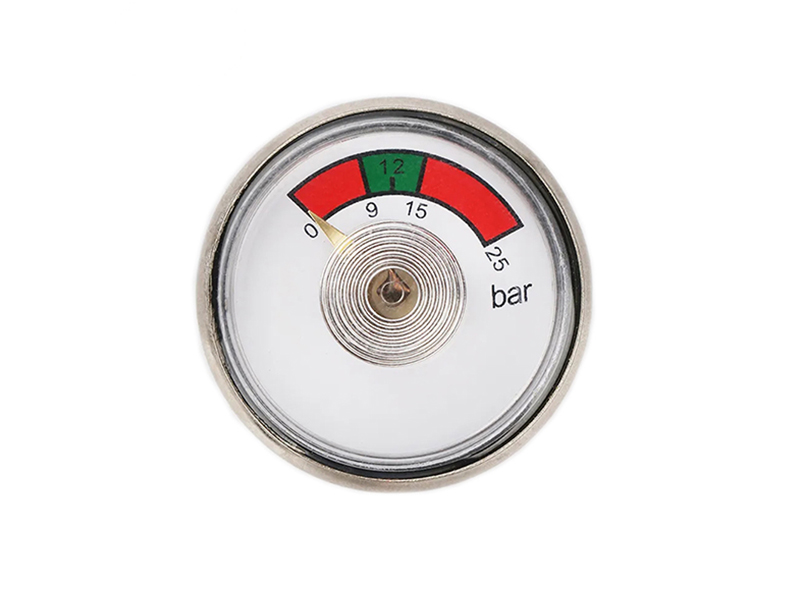
PG-14 Fire Extinguisher Pressure Gauge
25 mm, 32 mm, or 40 mm dial, 1/8 inch NPT connection, 60 to 2000 psi spiral tube, ANSI/ASME Grade B accuracy.
View Product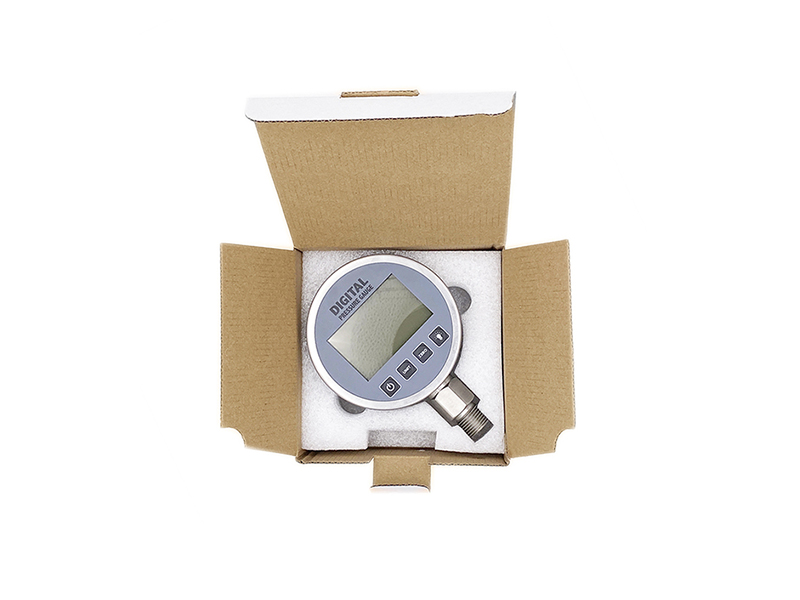
PG-10 Digital Pressure Gauge
Five-digit LCD, 0.4 percent full-scale accuracy, 304 stainless steel case, 150 percent overload rating.
View Product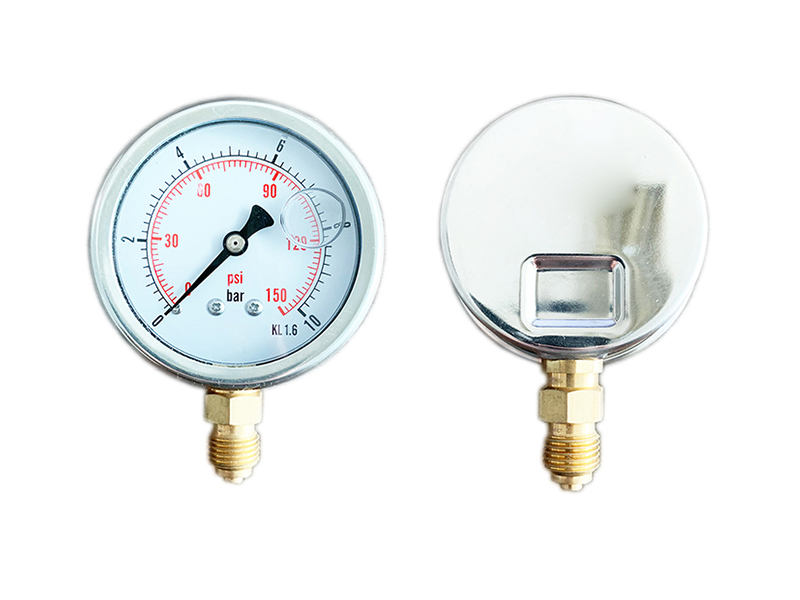
PG-2 Stainless Steel Case Gauge
304 stainless steel case, 1.6 percent or 1.0 percent accuracy, suited to vibration and corrosion exposure.
View Product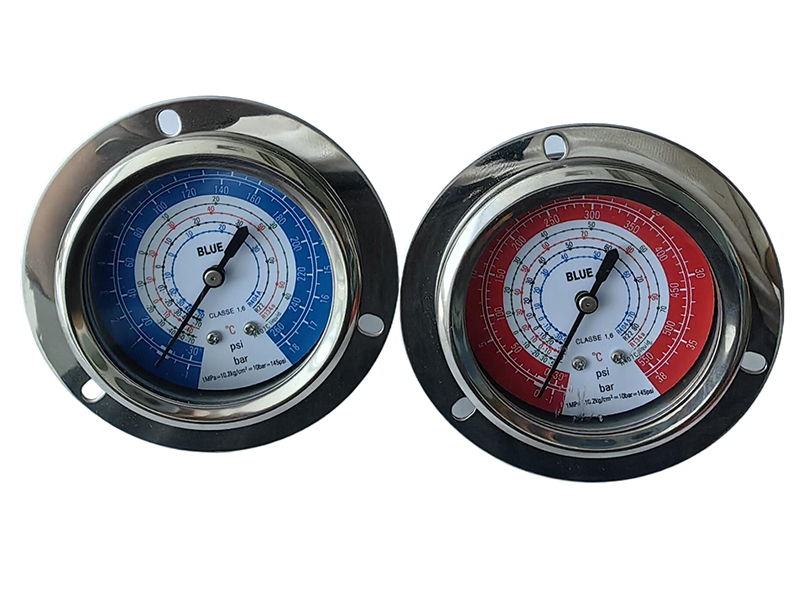
PG-09 Refrigerant Pressure Gauge
Color-coded dial for refrigerant circuits, with the same sealed movement used across the gauge range.
View ProductConclusion
The fire extinguisher pressure gauge is small, and its importance is easy to underestimate. It provides accurate pressure monitoring, early detection of leaks and damage, compliance with safety standards, and protection against failure. Without it, millions of extinguishers would sit on walls in a condition nobody could verify, and the first sign of trouble would arrive at the worst moment.
Understanding these four advantages is the practical part. Checking the fire extinguisher pressure gauge monthly, acting on anything outside the green band, and keeping service records current turns ordinary hardware into a dependable part of a fire plan. The next time you walk past an extinguisher, look at the dial. If you specify these instruments, our team can help you match dial size, thread, and range to your platform.
Frequently Asked Questions
What do the colors on a fire extinguisher pressure gauge mean?
Red on the lower side of a fire extinguisher pressure gauge dial means pressure is too low, so the unit cannot discharge normally and needs recharging or repair; green is the operating range, where the extinguisher is ready to use. Above the green band the unit is over-pressurized, which carries a risk of case failure and must be corrected by a trained technician. Some manufacturers print that upper sector in yellow rather than red, so read the position of the needle rather than the color name.
Why do some gauges show over-pressure in yellow while others show it in red?
Dial artwork is set by each manufacturer, and there is no single convention for the over-pressure sector: a two-color dial runs red from the lower limit through the upper limit, while a three-color dial inserts a yellow sector above the green band. Both express the same condition, and what matters is whether the needle is inside the green band, not what the sector above it is called.
Can I adjust the pressure on my own?
No. Bleeding gas from a cylinder or opening a unit to release dry chemical is dangerous, and it can leave the extinguisher looking normal on the dial while performing badly in use. Recharging and pressure correction belong to trained service personnel with the correct equipment.
How often should an extinguisher be checked and tested?
Visual inspection of the fire extinguisher pressure gauge is recommended monthly, with the needle confirmed inside the green band. Professional maintenance follows an annual cycle, and hydrostatic testing follows the interval for the shell type. For stored-pressure dry chemical units with low-carbon steel, brass, or aluminum shells, the federal table sets a 12-year hydrostatic test interval with a 6-year internal examination, while stainless steel dry chemical and CO2 shells are tested every 5 years. (Corrected: an earlier version of this article gave a two-year interval for dry chemical units; the applicable federal interval is 12 years. See note 1.)
What exactly is a fire extinguisher pressure gauge?
It is a small dial on the valve assembly that indicates whether the cylinder is properly pressurized (green), under-pressurized (red), or over-pressurized (red or yellow, depending on the dial), reading the same stored charge that propels the agent out of the hose.
1. 29 CFR 1910.157, Portable fire extinguishers, U.S. Department of Labor, including Table L-1 hydrostatic test intervals. https://www.osha.gov/laws-regs/regulations/standardnumber/1910/1910.157
2. Choosing and Using Fire Extinguishers, U.S. Fire Administration. https://www.usfa.fema.gov/prevention/home-fires/prepare-for-fire/fire-extinguishers/
3. Fire Extinguishers - Portable, Canadian occupational health and safety agency. https://www.ccohs.ca/oshanswers/safety_haz/fire_extinguishers.html




View More(Total0)Comment lists