



Bimetal vs. Gas-Filled Industrial Thermometers: Key Differences
 Nov 16, 2026|
 View:16
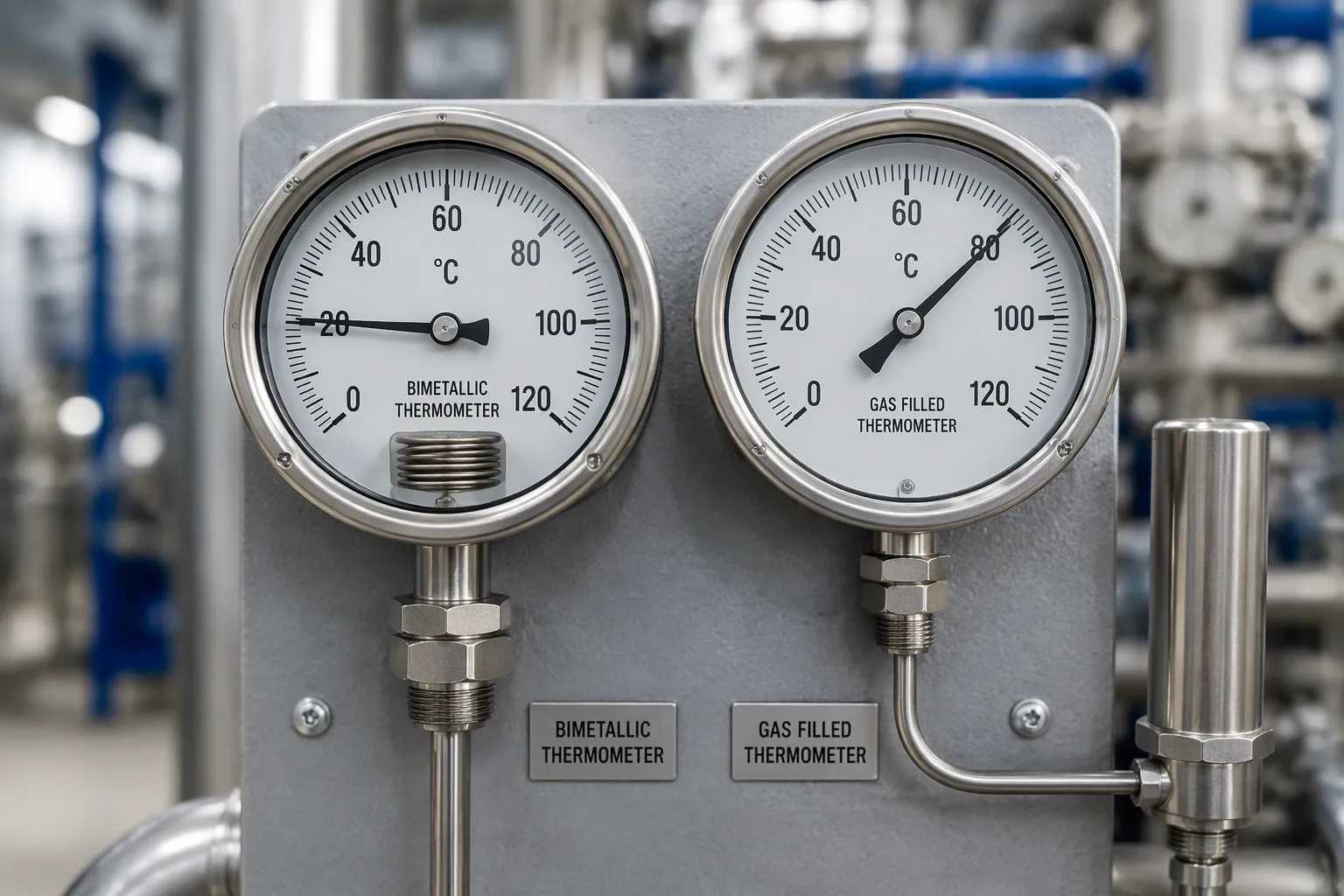
A dial thermometer either carries its sensing element inside the stem or pushes the reading through a capillary to a head mounted somewhere else. That one decision explains most of what separates a bimetal thermometer from a gas-actuated thermometer. Both are mechanical, both read without power, and both still earn a place in plants that run transmitters elsewhere. The choice is not a ranking. It comes down to the span the process needs, how far the reader stands from the tapping point, what the ambient does to the head, and the cost per measuring point. This article compares the two designs on those four factors and marks where published data ends and a datasheet check begins.
Key Takeaways
A bimetal thermometer keeps the sensing coil inside the stem, so the dial sits at the measuring point and no capillary has to be routed or protected.
A gas-actuated thermometer separates the bulb from the head, which buys reading distance and a cold end far below what a bimetal thermometer coil reaches.
Response time does not rank by type. The mass of the sensing element and the thermowell dominates, so ask for a T50 or T90 figure measured with your stem or bulb and your well.
A gas-actuated system carries one error source a bimetal thermometer does not have: the ambient temperature around the case and capillary enters the reading as head error.
Neither design needs a power supply. Whether either may go into a classified area depends on the certification of the complete instrument, not on the measuring principle.
Bimetal vs. Gas-Actuated Thermometers at a Glance
Two Dial Thermometer Technologies
Both designs present a value on a circular dial and both belong to the same family of mechanical temperature instruments used across process plants, marine systems and utility networks. The similarity stops at the case. A bimetal thermometer drives its pointer from a coiled strip inside the stem, so the element that senses and the element that indicates are one part. A gas-actuated thermometer drives its pointer from a Bourdon tube responding to the pressure of a sealed gas charge, with the bulb and capillary forming the rest of the system.
Span, reading distance, sensitivity to ambient temperature and cost all follow from that difference. Neither principle is better in general terms, and each one answers a defined set of process conditions.
Shared Strengths in Harsh Environments
Both types tolerate vibration, moisture and dust when the case is specified to the site's ingress protection requirement, and both hold calibration without electronics to drift or batteries to fail. Neither needs wiring at the measuring point, which is why mechanical instruments of both designs survive in plants where the control loop already belongs to a transmitter. The overlap is real but narrow: once a process needs a wider span or a reading position away from the tapping point, the bimetal thermometer and the gas-actuated unit stop being interchangeable.
How a Bimetal Thermometer Works
Bonded Metals and Differential Expansion
A bimetal thermometer uses two metal strips bonded along their full length. The pair works because the metals expand at different rates: brass runs about 18–19 ×10-6 per K against carbon steel at about 10.8–12.5 ×10⁻⁶ per K, a mismatch of roughly 7 ×10⁻⁶ per K (published linear expansion coefficients). Heat at the sensing stem makes one layer grow faster than the other, and because the pair cannot slide apart, the strip curls toward the slower-expanding side.
Manufacturers wind the strip into a helix or spiral, with one end fixed to the stem and the other on the pointer shaft. A small temperature change produces a measurable rotation, so a bimetal thermometer converts heat into mechanical motion with no fluid, no capillary and no power supply.
Dial Size, Range and Accuracy
The TM-8 bimetal thermometer is cataloged in 50 mm, 63 mm, 80 mm and 100 mm dials, with a stainless steel 304 case, a 100 mm to 200 mm stem at 8 mm diameter and a 1/2 inch BSP connection. Published ranges are -40 to +60 °C, 0 to 100 °C, 0 to 120 °C and 0 to 150 °C, at an accuracy of ±2.5% of full scale.
That accuracy figure decides whether the instrument is usable at all. On a 0 to 150 °C dial, ±2.5% of full scale works out to about ±3.8 K, which is fine for a pump discharge and not fine for a process that has to hold a setpoint. Where the span runs outside the published band, confirm the model against the catalog rather than assuming it; a selection guide for high-temperature duty covers the wider case.
Strengths and Limitations
Simplicity is the defining strength. The sensing element sits inside the stem, so the reading is local and immediate, with no bulb to rupture and no capillary to route, and installation takes one threaded connection. That suits pumps, storage tanks, pipelines, marine panels and any line where an operator stands beside the tapping point.
The limitations follow the same geometry. The spiral carries thermal mass, and a wide span squeezed onto a 50 mm face compresses the scale until the divisions stop being readable. A bimetal thermometer is also local by construction: extending the reading position means adding a capillary, which is a different product family rather than an accessory.
How a Gas-Actuated Thermometer Works
Gas Expansion and Capillary Systems
A gas-actuated thermometer, also called a gas-filled thermometer, uses a sealed bulb charged with inert gas, connected to the head by a thin tube called a capillary. The whole assembly is one closed pressure system: heat at the bulb changes the internal pressure, and a Bourdon tube in the case turns that pressure into pointer movement. The reading therefore follows the bulb, not the head.
The same principle is built with a liquid fill instead of a gas. Both belong to the filled-system family, and the remote-reading thermometer range covers the capillary models in either fill. Both fills are chosen when the bulb and the reader cannot share a location, so the head can sit at a safe viewing height while the bulb stays in a tank, duct or pipeline.
Strengths and Limitations
Span is the first advantage. Published gas-actuated ranges reach down to roughly -200 °C and up to roughly +650 °C, a far lower cold end than a bimetal coil covers. Reading distance is the second: a capillary puts the head on an aisle, a panel or a gangway while the bulb stays in the process.
The limitations are the price of that architecture. A sealed system has to stay sealed, so the bulb needs protection and the capillary has to be routed clear of sharp bends, crushing and sustained vibration. Ambient temperature acts on the head and capillary as well as on the bulb, which introduces a head error a bimetal thermometer never has to manage. The gas charge, bulb and capillary also add cost.
Where the Two Designs Actually Differ
Temperature Range
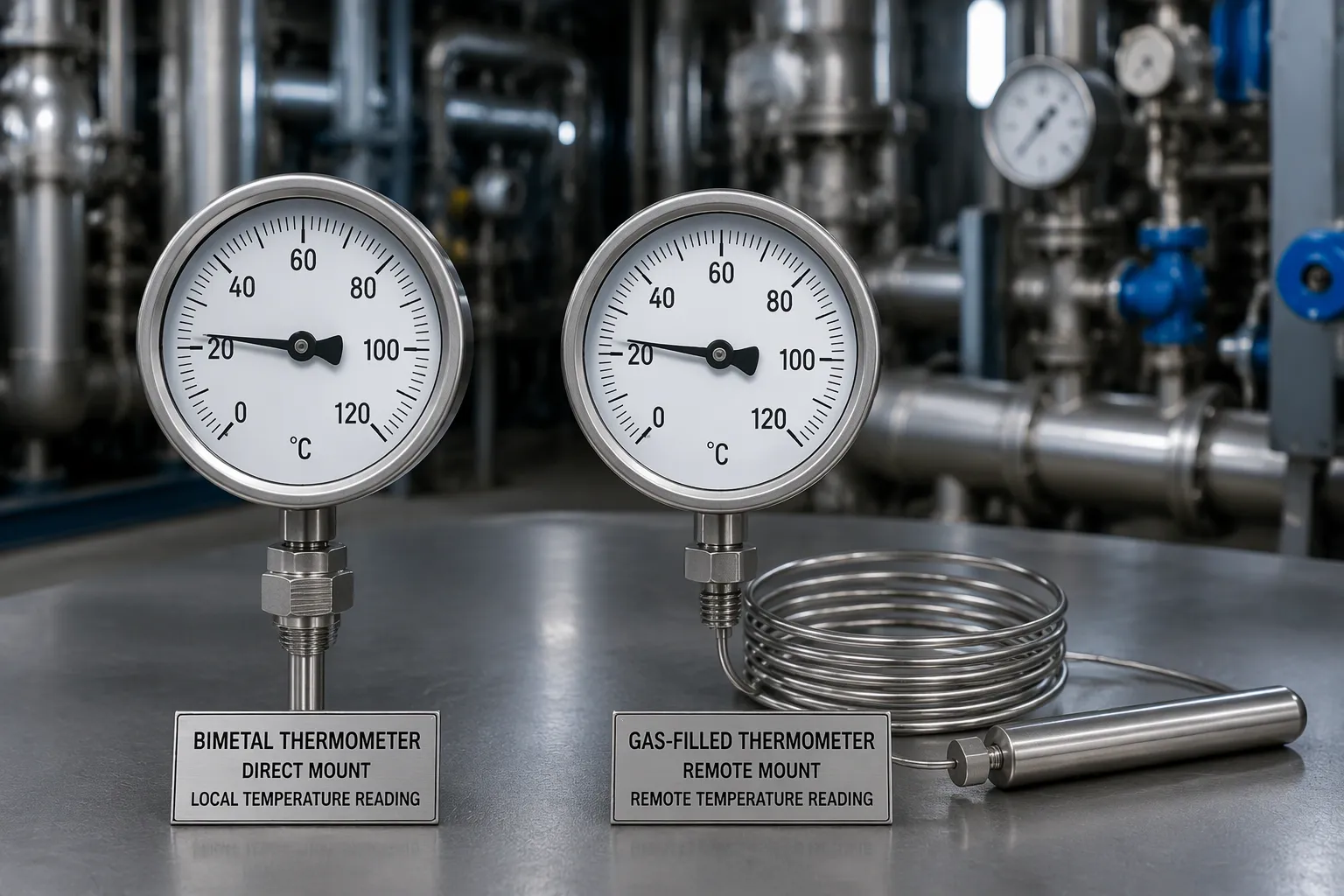
The honest version of "wider range" is narrower than the usual claim. A bimetal thermometer is not limited to ambient temperatures: catalog ranges commonly run from -40 to +150 °C in the usual dial sizes. What a gas-actuated instrument adds is mainly the cold end, where published spans reach roughly -200 °C, plus the ability to carry one large span on one dial without losing readability.
So the question is where the process sits, not which type wins. A chilled-water or brine line near -40 °C is outside the standard bimetal thermometer band and inside a gas-actuated one. A steam header at 180 °C fits neither comfortably and belongs to a thermocouple or RTD discussion.
Accuracy and Resolution
Accuracy is quoted as a percentage of full scale, and that is the number that decides usability. A cataloged ±2.5% of full scale on a 0 to 150 °C dial works out to about ±3.8 K. Published filled-system figures commonly sit between ±1% and ±1.5% of full scale. Neither is a defect: they are different products built for different tolerances.
Resolution is a separate matter. A wide span on a small dial compresses the scale, and no accuracy figure recovers divisions the eye cannot separate. If the span is wide, the dial has to be large, whichever principle is chosen.
Response Time
Response time is where published comparisons usually stop being useful, because the numbers are rarely measured under the same conditions. What dominates is the thermal mass between process and element: stem diameter, bulb size, and above all the wall thickness of the thermowell. A heavy bulb in a thick well reacts more slowly than a slender bimetal thermometer stem in a thin pocket, and a bimetal thermometer stem in a heavy well reacts more slowly than a small capillary bulb in a fast-moving line.
The practical rule is to ask for a T50 or T90 value measured with the actual stem or bulb and the actual well. A supplier who quotes a response time without saying which well it was measured in has not given you a number you can compare.
Remote Reading and Ambient Error
Remote reading is a genuine split. A bimetal thermometer mounts at the measuring point and removes all routing concerns; a gas-actuated or liquid-filled thermometer moves the head to where a reader can stand safely, at the cost of a capillary to plan.
The ambient error is what buyers discover after installation. A filled system reads the pressure of a closed charge, so the temperature of the head and the capillary is part of the measurement chain: a head in direct sun, beside a steam line or inside an unventilated enclosure drifts away from the bulb temperature. A bimetal thermometer has no such path, because only the stem sits in the thermal circuit. Route the capillary clear of hot surfaces, keep the head out of sun, and confirm the manufacturer's ambient compensation figure before commissioning.
Installation and Environment
Mounting and Thermowells
A bimetal thermometer installs through a single threaded connection, with the stem entering the pipe, tank or duct directly and the dial at that same spot. Common options are direct stem mounting, adjustable-angle heads and thermowell insertion for protection and easy removal. A filled-system instrument needs more planning, because the capillary has to be supported and routed clear of sharp bends, crushing and continuous vibration.
Both types accept thermowells, which protect the element from corrosive media and allow removal without breaking the process seal. Two checks belong in the specification: well depth and heat-transfer medium, since a stem or bulb that only partly fills the well reads the well rather than the process; and immersion against pipe size, since a short immersion in a small line picks up wall temperature instead of fluid temperature.
Hazardous Areas
Both designs are mechanical and neither needs an electrical supply at the measuring point, so neither adds an electrical ignition source. That is a real advantage, but it is not the whole test. Explosion protection belongs to the complete certified instrument rather than to the measuring principle, and the ATEX directive (2014/34/EU) covers non-electrical equipment as well as electrical equipment. A bimetal thermometer or a filled system in a classified area still needs an assessed ignition-risk rating covering its housing, its materials and, on the filled design, its capillary.
The specification has to state the requirement and the datasheet has to confirm it. Where no certificate is listed for the model under consideration, treat the instrument as uncertified for that area, whatever the measuring principle suggests.
Specification Comparison
Reference Table
Bimetal figures below are the cataloged values for the TM-8 series. Gas-actuated figures are typical values quoted across manufacturer catalogs and should be confirmed for the model actually quoted.
Reference Point | Bimetal Thermometer | Gas-Actuated Thermometer |
|---|---|---|
Catalog ranges | -40 to +60 °C, 0 to 100 °C, 0 to 120 °C, 0 to 150 °C (TM-8) | Published spans reach roughly -200 °C to +650 °C |
Accuracy at full scale | ±2.5% of full scale (TM-8) | Commonly ±1% to ±1.5% of full scale |
Dial size | 50, 63, 80, 100 mm | Typically 4.5 to 6 in (114 to 152 mm) |
Sensing element | Spiral coil inside the stem, 8 mm diameter | Sealed bulb 10 to 12 mm diameter plus capillary |
Reading distance | Local only, dial at the stem | Remote, capillary 1.5 to 10 m in catalog lengths |
Ambient effect on reading | None from case temperature | Head and capillary temperature enters the reading |
Power supply | None | None |
Classified area | Certification of the model decides | Certification of the model decides, capillary included |
Relative cost per point | Lower | Higher, driven by bulb, capillary and gas charge |
Two rows deserve a second look. The ambient row changes over a service life, because a head that was fine at commissioning can drift once an enclosure is closed or a nearby line starts up. The classified-area row has to be closed before the purchase order, not after delivery.
Need a datasheet for a specific range, dial size or capillary length? Send the process conditions and we will confirm the model.
Get a QuoteChoosing the Right Thermometer
When a Bimetal Thermometer Fits
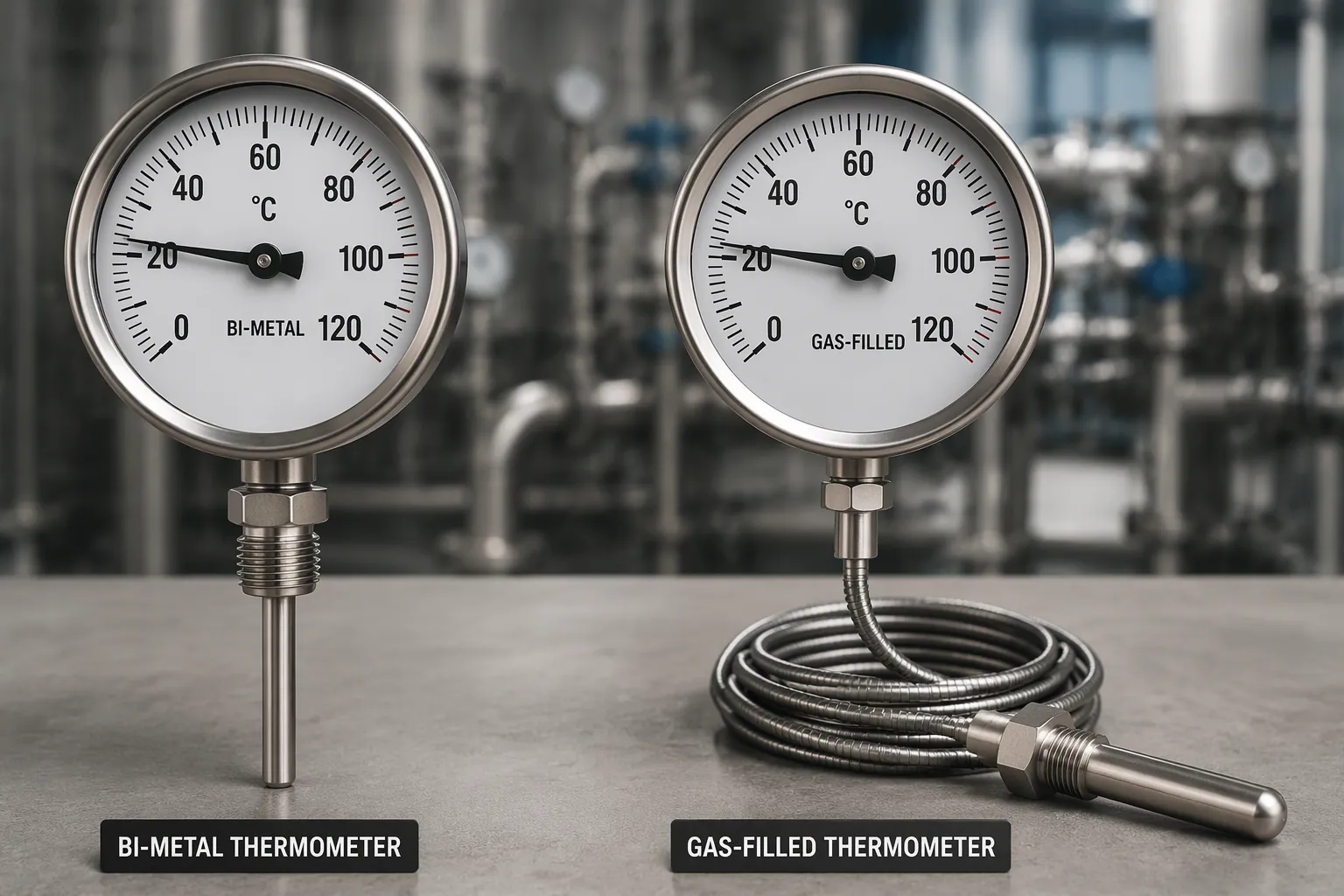
A bimetal thermometer fits when three conditions hold at once: the reader can stand at the measuring point, the span stays inside the catalog band, and the tolerance the process needs is looser than a few kelvin. A pump discharge line, a tank wall, a marine panel and a utility header meet those conditions, and the direct mount removes the routing work a capillary would need.
Cost per point is the second argument. A facility monitoring dozens of lines pays for simplicity at every one of them, and a bimetal thermometer with no capillary to protect and no sealed charge to check is a simpler maintenance item than a filled system.
When a Gas-Actuated Thermometer Fits
A gas-actuated thermometer fits where the bulb and the reader cannot share a place: a cold end at or below -40 °C, a vessel with difficult access, an elevated pipe run, or a congested or hot zone where an operator should not stand at the tapping point. The capillary buys that distance, and the price of the distance is routing, support and ambient protection.
When Neither Fits
Both designs are dial indicators, and a dial indicator is the wrong answer in three situations. A process that has to hold a setpoint tighter than a percentage of full scale needs a thermocouple or RTD with a transmitter. A reading that has to reach a control room, a historian or an alarm needs a signal, not a dial. A temperature that changes faster than a mechanical element can follow needs a small time constant rather than a heavier element in a well. A bimetal thermometer chosen for a duty it cannot hold becomes a reference the control system ignores.
Two Models That Cover These Cases
TM-8 Industrial Bimetal Thermometer
Local reading with no capillary. Stainless steel 304 case, 50 to 100 mm dial, -40 to +150 °C catalog ranges, ±2.5% of full scale.
View productTM-6 Capillary Remote-Reading Thermometer
Filled-system remote reading. Stainless steel 304 case, 100 mm dial, silicone oil filled, ±1.5% of full scale, capillary 1.5 to 10 m.
View productThe TM-8 is listed in the industrial bimetal thermometer range and the TM-6 in the remote-reading range, so the two options can be compared on the same process conditions before either is ordered.
Not sure which of the two fits your line? Send the medium, the temperature band and the reading position.
Contact UsConclusion
The bimetal vs. gas-actuated thermometer decision comes down to one trade-off. A bimetal thermometer keeps the sensing element and the dial in one place, which makes it simple, cheap per point and free of ambient error. A gas-actuated thermometer moves the reading to where a person can stand safely and reaches a lower cold end, at the cost of a capillary to route and a head error to manage.
Four questions settle most selections: how wide is the span and does it go below -40 °C, how far is the reader from the tapping point, what sits around the head and will its temperature change over the year, and what tolerance the process actually needs. An instrument chosen from those answers holds its place; one chosen from habit gets replaced.
Changzhou KB Instruments & Meter Co., Ltd. builds both families: the TM-8 bimetal thermometer for local reading and the TM-6 capillary thermometer for remote reading, with the ranges and capillary lengths listed above.
FAQ
Which dial size should I choose for a bimetal thermometer?
Match the face to the reading distance and the span, not to the panel cutout alone. A 50 mm face suits a close reading and a narrow span, while a 100 mm face keeps the divisions readable when the span is wide or the reader stands back. If the span is wide and the dial stays small, the scale becomes the limit before the accuracy does.
Can both thermometer types be installed in a thermowell?
Yes. A thermowell protects the element from corrosive media and allows removal without breaking the process seal. A bimetal thermometer inserts its stem directly, while a gas-actuated or liquid-filled unit places the bulb inside the well and routes the capillary to the head. In both cases the well must be deep enough and carry a heat-transfer medium, or the instrument reads the well instead of the process.
How do I decide between local and remote reading?
Local reading fits an accessible tapping point and a reader who can stand there. Remote reading fits a hot, congested or classified point, or a head that belongs at eye level on a panel. The decision is about where a person can stand, not about which design is more modern.
What should I confirm on the datasheet before ordering?
Confirm the range and accuracy class, dial size, stem or bulb dimensions, capillary length, connection thread and case material. Add three items that are usually missing: the ingress protection rating, the response time with the specified well, and the certification for a classified area. Where a figure is not listed, treat it as unconfirmed rather than as a default.
Does either type need routine maintenance?
Both hold calibration in normal service, and periodic visual inspection covers most of what is needed. A filled system adds a check a bimetal thermometer does not have: the bulb, capillary and charge have to stay intact and leak-free, and the head has to stay out of sun and away from hot surfaces so the ambient error does not grow.
Sources
Expansion coefficients for brass and carbon steel: Engineering ToolBox, Linear Thermal Expansion Coefficients of Materials. Bimetallic strip behavior: University of California, Santa Barbara, Physics Lecture Demonstrations, Bimetallic strip (48.09). Ranges, dial sizes and accuracy for the bimetal thermometer, and capillary lengths for the remote-reading model: TM-8 and TM-6 datasheets on this site. Gas-actuated span and accuracy bands are typical values quoted across manufacturer catalogs and must be confirmed against the model datasheet.






View More(Total0)Comment lists