



Liquid-Filled vs. Dry Pressure Gauges: Which to Choose?
 Nov 03, 2026|
 View:6

For vibration-prone applications, liquid-filled gauges are generally the better choice. The fill fluid, often glycerin or silicone, cushions the pointer and protects the movement from wear. The liquid stabilizes the needle and reduces the impact of sudden pressure spikes. Dry gauges remain a valid fit in calm, clean service where cost matters most. The right answer depends on the actual conditions at the installation point. Vibration level, pulsation, temperature, and media compatibility all shape the decision. A careful review of liquid-filled versus dry pressure gauges pays off in longer service life and steadier readings.
Key Takeaways
Liquid-filled gauges use fluid to steady the needle and protect the movement from vibration damage.
Dry gauges work best in clean, stable places where vibration is low and cost matters most.
Choose the right fill fluid for your temperature range: glycerin for moderate conditions, silicone for extreme cold or heat.
Open the vent plug after installation to prevent trapped pressure from causing wrong readings.
Avoid glycerin fill with oxidizing chemicals like chlorine or oxygen; use halocarbon instead.
Liquid-Filled vs. Dry Pressure Gauges: Core Differences
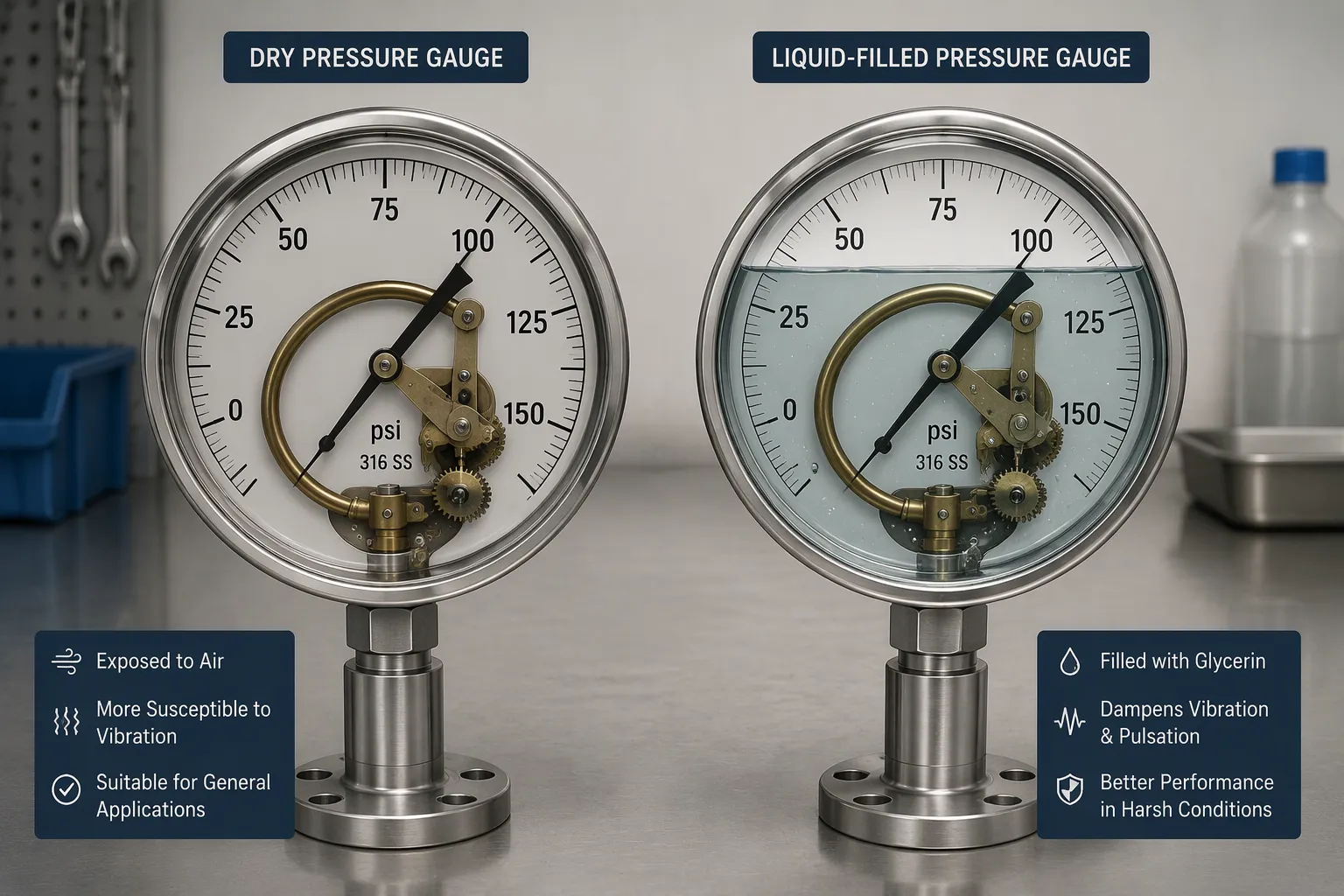
The two gauge types share the same measuring mechanism. A Bourdon tube uncurls as pressure rises, and a link and gears translate that motion into pointer movement. The difference lies in what surrounds that mechanism inside the case.
Dry Gauge Construction
A dry gauge holds air inside its case. The Bourdon tube, socket, movement, and linkage sit exposed to that air. The external casing protects the internal mechanism from physical damage, and stainless steel is commonly selected for strength, corrosion resistance, and durability under demanding conditions. Sealing components such as gaskets and O-rings keep the system leak-tight. A solid-front case incorporates a rear blow-out plug that directs force and debris away from the operator during an overpressure event, while an open-front design may expose personnel or equipment to greater risk. The movement and linkage connect through a pivot point to a geared movement. Machined components and finer gears deliver higher accuracy and longer endurance than stamped parts, and stainless steel outlasts copper alloy.
The air-filled design keeps construction simple and cost low. It suits clean, stable service where vibration is minimal. The trade-off appears under motion. Ambient air carries moisture, which can condense on the inside of the window when temperature drops. Below freezing, that condensation can ice up and lock the movement. The geared linkage also hammers itself under pulsation, and links, pivots, and pinions wear over time.
Liquid-Filled Construction and Fill Fluid
A liquid-filled gauge replaces that air with fluid. Glycerin is the most common choice, though glycerin-water mixes, silicone oil, and halocarbon fluid also appear. Cases are typically filled to about 80–90% of their volume, never to the top, leaving room for thermal expansion. The case ships with a sealed fill plug, and after mounting the installer cuts the vent nipple or flips the vent lever so the case can breathe.
The fluid surrounds the movement and changes how the gauge behaves. The liquid damps pointer motion so the needle holds steady under vibration and pulsation. It also bathes the links, pivots, and pinions in lubricant, which slows mechanical wear. Filling the cavity lubricates and dampens the internal components to reduce or eliminate the effects of heavy vibration and pulsation. Because no ambient air remains, the window stays clear in rain, washdown, and winter conditions, and humid air and corrosive products cannot get in and condense on the internals.
Fill fluid choice matters. Glycerin is generally the most viscous fluid, making it a better dampening agent, though it may impact tolerance below 20 °F and discolor above 150 °F. Silicone covers -40 °F to 200 °F with less viscosity but still makes a significant impact on longevity. Halocarbon serves oxidizing media.
Accuracy grades stay the same either way on the spec sheet. In vibrating service, the dry gauge flutters while the liquid-filled gauge gives a readable, steady pointer. That makes usable field accuracy better with fill. Comparing oil-filled and dry models therefore comes down to service conditions, not the measuring principle.
How Vibration and Pulsation Cause Damage
Vibration and pulsation attack a gauge through two paths. One path affects what the operator sees. The other path affects the mechanism inside the case. Both paths shorten service life, and both appear more quickly in a dry gauge.
Pointer Flutter and Readability Loss
Pointer flutter occurs when vibration or pulsation acts on the gauge. The needle oscillates around the true reading instead of holding steady. Strong vibrations not only cause pointer flutter but also cause permanent damage to the mechanics, considerably reducing service life. The operator cannot tell which part of the swing reflects actual pressure. A pump cycling nearby or a compressor pulsing downstream produces this effect continuously.
Condensation adds a second readability problem. Moisture can build up on the inside of the window and reduce visibility, and in cold conditions the entire window can frost over. Filling liquid prevents window frosting and guarantees unimpeded readability. A dry gauge offers no such protection. Our gauge selection guide for marine use shows how this comparison affects daily operation, not just long-term durability.
Movement Wear and Calibration Drift
Constant oscillation accelerates wear on the sector gears, linkage, and pinions, according to our engineering experience at KB Instruments. That mechanical stress leads to erratic movement, calibration drift, and premature failure. Excessive pulsation and vibration remain two of the leading causes of internal wear, pointer instability, and premature gauge damage. The table below summarizes how each vibration pattern affects a dry gauge.
Mechanism | Effect on dry pressure gauge |
|---|---|
Excessive pulsation and vibration | Leading causes of internal wear, pointer instability, and premature damage |
High-frequency vibration | Localized wear on movement gear teeth |
Low-frequency vibration | Broader stress on the Bourdon tube and internal components |
Pointer movement exceeding about 5% of full-scale range | Corrective action required |
From our factory floor experience, we've seen several practical warning signs recur:
Continuous needle oscillation accelerates wear on sector gears, linkage, and pinions.
A dry gauge offers no protection against pulsation and works only on steady systems without mechanical disturbance.
Rhythmic bouncing from pump pulsation or vibration requires a snubber or liquid-filled gauge.
Erratic bouncing with sticking or jumping points to worn internal parts, and replacement is the correct response.
Liquid fill limits these effects by damping the movement and lubricating the wear points. Dry gauges remain more susceptible to vibration damage and pressure spikes.
How Liquid Fill Dampens Vibration
Damping Action on the Movement
The fill fluid works as a dashpot. The mechanism behaves like a piston moving through a viscous medium that dissipates kinetic energy. The pointer and linkage push through glycerin or silicone on every stroke, and the fluid absorbs that motion instead of passing it to the gears. The result is a stable needle reading even when pressure at the sensing element fluctuates.
This damping carries a measurable cost in response speed. Our engineering tests confirm that a liquid-filled gauge responds 20–40% slower than a dry gauge. The trade is deliberate: a slightly slower needle in exchange for a steady one. The fluid also lubricates the moving parts, seals out moisture and corrosive gases, and cushions the Bourdon tube against pressure surges. Extensive field data and our own factory validation confirm that mechanical vibration destroyed gauges fitted with movement dampening but without liquid filling. The fill itself provides the critical protection against vibration-induced fatigue.
When to Add Snubbers or Diaphragm Seals
Liquid fill handles mechanical vibration well. It does not replace a snubber or diaphragm seal when pulsation or media protection demands one. Pumps and valves produce pulsation, surges, and spikes, and an external snubber or dampener may be needed when fluctuations are expected. We recommend a snubber for reciprocating pumps, piston compressors, hydraulic power units, and high-cycle pneumatic systems. Warning signs include a pointer that swings rapidly, broken movements, loose pointers, and frequent recalibration.
The practical rule is simple. Specify a liquid-filled gauge first to control vibration in demanding service. Add a snubber or diaphragm seal only when the process itself calls for it. This staged approach keeps our gauge selection decision grounded in actual conditions rather than habit.
Temperature, Weather, and Fill Fluids
Glycerin, Silicone, and Other Fill Fluids
Fill fluid selection follows the ambient and process temperature at the installation point. Pure glycerin thickens noticeably below about 63 °F and a standard glycerin-filled gauge can stop functioning around 23 °F. A 2:1 glycerin-water mix works down to roughly −51 °F for cold climates. Silicone oil covers the extremes on both ends and is the standard choice above 140 °F or below −4 °F. KB Instruments recommends glycerin for 35 °F to 150 °F and silicone from −100 °F to 150 °F. Halocarbon suits oxidizing agents such as chlorine, oxygen, and hydrogen peroxide.
Fill Fluid | Effective Range | Best Fit |
|---|---|---|
Glycerin | 35 °F to 150 °F | Moderate ambient conditions, strong dampening |
Silicone | −100 °F to 150 °F | Extreme cold, icing risk, wide temperature swings |
Halocarbon | −4 °F to 140 °F | Oxidizing media |
Weather exposure favors liquid fill. Oil-filled gauges work well in cold and wet places where dry gauges might not, and the oil layer keeps the pointer steady. Ambient or process temperatures above 150 °F can discolor the dial and harden the gasket, and glycerin fill with acrylic windows tends to yellow near 200 °F.
Venting and Outdoor Installation
Fill fluid expands and contracts with temperature. Many liquid-filled gauges need case venting or a pressure-compensating plug so internal case pressure does not shift the pointer or stress the window. A plug left closed when venting is required can bias the pointer. A plug left open in washdown or dirty areas lets contamination enter.
Installation follows a short sequence recommended by our KB Instruments engineering team:
Match the seal to the thread type. Use sealing rings or gaskets on parallel threads and PTFE tape on tapered threads.
Leave at least 15 mm (about 1/2 inch) of free space behind the blowout preventer.
Open the compensation valve to release shipping pressure, then close it to block ingress.
After mounting, set the valve from closed to open.
We advise following the manufacturer's recommendation, since washdown areas and outdoor exposure often favor sealed cases.
Media Compatibility and Safety
Wetted Materials and Fill Fluid Compatibility
Compatibility review covers two separate surfaces. Wetted components, including the sensing element and process connection, must resist the chemicals being measured. External components, such as the case, window, and seals, must withstand cleaning agents, splashes, and corrosive vapors. Both checks belong in the specification.
Material selection follows the process fluid. KB Instruments offers diaphragms and housings in PVC, PP, FRP, PVDF, 316 stainless steel, or PTFE, depending on the chemical involved. Our plastic gauge series comes in PVC, PP, and PVDF with a Teflon diaphragm, making the unit fully corrosion resistant. Gauge guards add another layer: a flexible diaphragm filled with inert fluid transmits pressure to the gauge, and both the diaphragm material and the fill must suit the process liquid.
Fill fluid temperature ratings also shape the choice. KB Instruments publishes the following ambient ranges by configuration:
Gauge configuration | Ambient temperature range |
|---|---|
Dry | -20°F to 200°F (-29°C to 93°C) |
Glycerin-filled | 20°F to 150°F (-7°C to 66°C) |
Silicone-filled | -40°F to 150°F (-40°C to 66°C) |
Halocarbon-filled | -40°F to 150°F (-40°C to 66°C) |
Avoiding Glycerin with Oxidizers
Glycerin is an organic compound, and it reacts with strong oxidizers. KB Instruments recommends halocarbon fill for oxidizing agents such as chlorine, oxygen, and hydrogen peroxide. Glycerin, silicone, and halocarbon remain the standard fill options, which gives specifiers a workable alternative when the media is reactive.
Confirm fill fluid and wetted material compatibility with the process media before specifying any gauge, and select halocarbon fill for oxidizing service.
This check costs little at the quotation stage. It prevents seal degradation, fluid breakdown, and inaccurate readings once the gauge is in line.
Selection Guide: Liquid-Filled vs. Dry Pressure Gauges

Decision Checklist by Application
A short checklist turns the gauge selection decision into a repeatable process. The table below summarizes the trade-offs that matter most at the specification stage.
Feature | Dry Pressure Gauges | Liquid-Filled Pressure Gauges |
|---|---|---|
Cost | Lower | Higher |
Response speed | Fast | Relatively slower |
Readability under vibration | Poor; pointer flutters | Excellent; pointer stable |
Suitable environment | Stable conditions with low vibration | High vibration and frequent pressure fluctuations |
Protection | None | Lowers wear and corrosion; extends service life |
Temperature adaptability | Excellent; no fluid viscosity issues | Depends on fill fluid limits |
We recommend a sequence of practical questions. Identify the pressure source first. A pump, compressor, or hydraulic circuit produces pulsation and vibration, and these dynamic systems call for a liquid-filled gauge. Assess the installation environment next. Outdoor mounting, washdown, and humid conditions favor a sealed, liquid-filled case that blocks moisture ingress. Observe the behavior of any existing gauge. Pointer flutter or sticking signals a vibration problem that fill fluid will dampen.
Temperature and media checks follow. Standard glycerin fill is rated -20°C to +60°C, and silicone handles -40°C to +80°C. Specialty fluids reach down to -70°C for cryogenic or reactive conditions. Brass wetted parts suit water, air, and non-aggressive liquids or gases. Sour gas, ammonia, and harsh chemicals require stainless steel or Monel. Glycerin remains the standard fill for non-oxidizing service, and halocarbon suits oxidizers. Budget closes the review. Stable, clean indoor panels with rock-steady pressure favor dry gauges, while high-vibration equipment and harsh marine conditions justify the higher cost of liquid fill.
As a manufacturer serving wholesalers, chandlers, and exporters since 2009, KB Instruments supplies standard liquid-fillable gauges with bayonet rings, oil-filled gauges with record pointers, precision test gauges, and related accessories, all engineered to meet the demanding conditions outlined above.
Installation Tips for Longevity
Based on our factory experience, a filled gauge can fail early for several avoidable reasons: a wrong thread, use of the gauge as a wrench point, an impulse line that traps debris, or a range too low for startup pressure. Proper handling at mounting prevents most of these failures.
Open the vent plug after installation when the gauge shipped at one altitude and is installed at another, or when ambient temperature changes significantly. A closed plug can bias the pointer, and an open plug in washdown areas admits contamination.
Check the fill fluid and case design against actual ambient and process temperature, especially in direct sun, near steam piping, or in outdoor freezing conditions.
Address pulsation at the source with suitable piping, isolation, and damping before adding a snubber or needle valve. These accessories slow response and can plug in dirty service.
Plan maintenance in the RFQ. State whether the gauge can be isolated without draining the system and whether the window must tolerate cleaning chemicals.
Reject a filled gauge with a leaking case, discolored fill, sluggish pointer response, or a zero that does not return after isolation.
During acceptance, operate the gauge through its intended cycle and watch both indication quality and return to zero. A heavily damped pointer may look steady while hiding a blocked connection.
The decision rule stays simple. Liquid-filled gauges handle vibration and pulsation. Dry gauges suit clean, stable service. Add a snubber or diaphragm seal when conditions demand more protection.
The gauge selection rests on six factors. Check vibration level and pulsation first. Confirm the temperature range, then match the fill fluid to it. Plan venting for outdoor or washdown mounting. Verify media compatibility last, and avoid glycerin with oxidizers.
Every application differs in these details. Consult a gauge expert to match the instrument, fill fluid, and accessories to your specific service conditions before you specify.
FAQ
Are liquid-filled gauges always the better choice?
No. Liquid fill earns its cost under vibration, pulsation, and weather exposure. A dry gauge fits clean, stable, indoor service where budget drives the decision. Match the gauge to the actual conditions at the installation point.
Does fill fluid slow the gauge response?
Yes. A liquid-filled gauge responds roughly 20–40% slower than a dry gauge. The fluid absorbs pointer motion on every stroke. That trade buys a steady needle and longer movement life in vibrating service.
Which fill fluid should I specify?
Glycerin delivers the strongest dampening in moderate conditions. Silicone covers a wider temperature span and suits cold or icing risk. Halocarbon serves oxidizing media. Confirm the fluid rating against ambient and process temperature before ordering.
Should I add a snubber to a liquid-filled gauge?
Only when the process demands it. Liquid fill controls mechanical vibration. A snubber or diaphragm seal handles heavy pulsation or protects the gauge from aggressive media. Specify fill first, then add accessories for the specific condition.
Why does my filled gauge read wrong after installation?
The vent plug is likely still closed. Fill fluid expands with temperature, and trapped case pressure biases the pointer. Open the vent after mounting, then close it again in washdown or dirty areas to block contamination.
Need Help Selecting the Right Pressure Gauge?
Our engineering team at KB Instruments is ready to help you match the perfect instrument, fill fluid, and accessories to your specific service conditions. Get a free consultation and custom quote today.
Contact Our Engineering Team →I want to comment


Recent News
1.2026 IMPA Marine Guide: Decode Pressure Gauge & Thermometer Codes
2026-10-092.What Should You Look for in a Pressure Gauge Supplier?
2026-09-193.How to Choose a Reliable Pressure Gauge Manufacturer in China in 2026
2026-09-194.Pressure Gauge Bouncing or Drifting? 5 Causes and Calibration Guide
2026-09-28




View More(Total0)Comment lists