



Oil Filled Pressure Gauge vs Dry Pressure Gauge: Which One Is Better?
 Jul 28, 2026|
 View:470
Pressure gauges are widely used in industrial equipment to monitor and measure pressure changes in hydraulic systems, pneumatic systems, compressors, pumps, processing equipment, and manufacturing machinery. When selecting a suitable pressure measurement instrument, many engineers and purchasing managers need to choose between an oil filled pressure gauge and a dry pressure gauge.
Although both types of pressure gauges provide pressure readings, their internal structures, operating performance, durability, and application environments are different.
So, which one is better: an oil filled pressure gauge or a dry pressure gauge?
The answer depends on the working conditions, including vibration levels, temperature fluctuations, installation environment, and measurement requirements.
As a professional oil filled pressure gauge manufacturer, Changzhou KB Instruments provides various industrial pressure gauges designed for applications requiring stable performance, long service life, and reliable pressure monitoring.
What Is a Dry Pressure Gauge?
A dry pressure gauge is a traditional mechanical pressure measuring instrument without any liquid filling inside the case.
The internal components, including the Bourdon tube, movement mechanism, and pointer system, operate in a dry environment. When pressure enters the Bourdon tube, the tube deforms slightly, and the mechanical movement converts this deformation into a pointer indication.
Dry pressure gauges are commonly used in general industrial applications where vibration, pulsation, and environmental impact are limited.
Common Applications of Dry Pressure Gauges:
Air compressors
Water pumps
Pneumatic systems
HVAC equipment
General machinery
Low-pressure industrial systems
Because of their simple structure and competitive cost, dry pressure gauges remain a popular choice for standard pressure measurement applications.
What Is an Oil Filled Pressure Gauge?
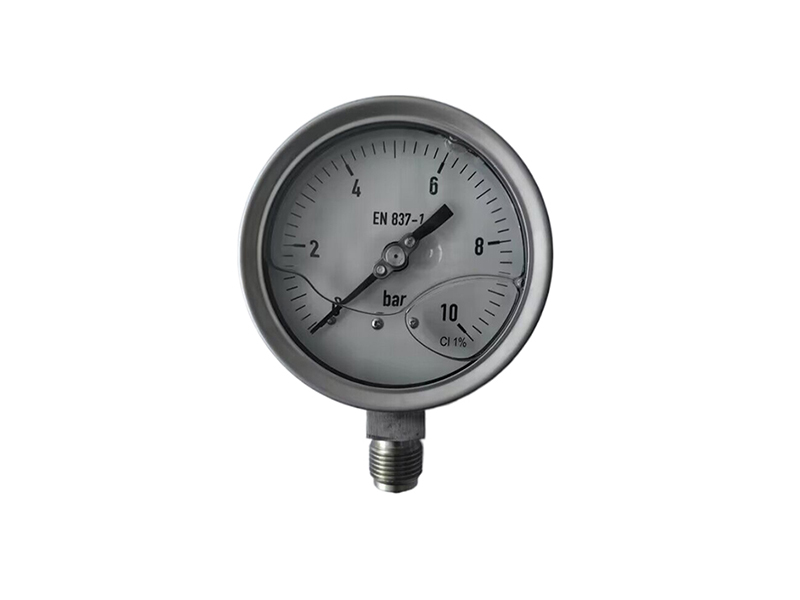
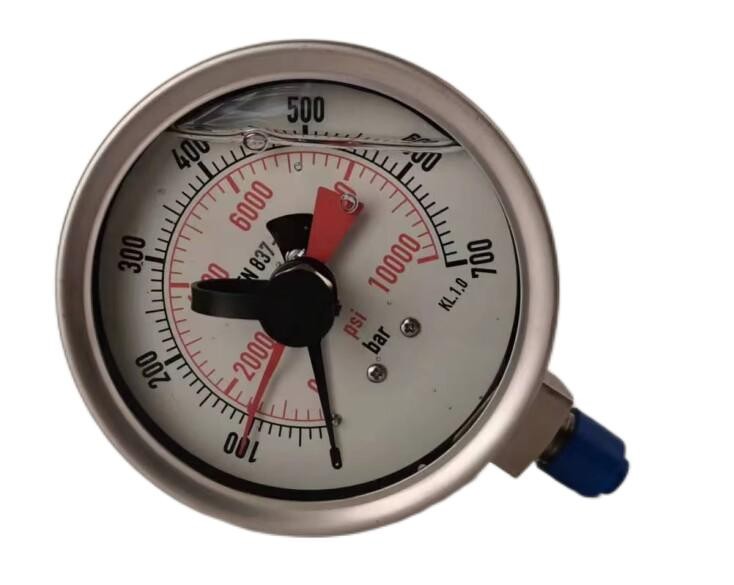
An oil filled pressure gauge is a pressure gauge filled with liquid, usually glycerin or silicone oil, inside the case.
The filling liquid surrounds the internal mechanism and provides damping protection against vibration, mechanical shock, and pressure pulsation.
Compared with dry pressure gauges, oil filled pressure gauges are designed for more demanding industrial environments where measurement stability and durability are important.
Common Applications of Oil Filled Pressure Gauges:
Hydraulic equipment
Construction machinery
Chemical processing systems
Oil and gas equipment
Industrial pumps
Compressors
Outdoor machinery
For industries where equipment experiences continuous vibration or pressure fluctuations, an oil filled pressure gauge supplier can provide a more suitable measurement solution.
Oil Filled Pressure Gauge vs Dry Pressure Gauge: Key Differences
| Comparison | Oil Filled Pressure Gauge | Dry Pressure Gauge |
|---|---|---|
| Internal design | Filled with glycerin or silicone oil | No liquid filling |
| Vibration resistance | Excellent vibration absorption | Limited vibration resistance |
| Pressure fluctuation handling | Suitable for pulsating pressure | Suitable for stable pressure |
| Reading stability | More stable pointer movement | Pointer may fluctuate |
| Service life | Longer in harsh environments | Suitable for normal conditions |
| Cost | Higher initial cost | More economical |
| Maintenance | Requires suitable filling liquid | Simple maintenance |
| Application environment | Heavy-duty industrial applications | General industrial applications |
1. Vibration Resistance: Oil Filled Pressure Gauge Has Advantages
Industrial machines often generate vibration during operation. For example, hydraulic systems, pumps, and compressors may create continuous mechanical movement that affects pressure readings.
A dry pressure gauge may experience:
Pointer vibration
Unstable readings
Faster mechanical wear
An oil filled pressure gauge uses liquid damping technology to reduce movement inside the gauge. The filling fluid absorbs mechanical vibration and helps maintain steady pointer movement.
Therefore, for equipment with strong vibration, an industrial pressure gauge with liquid filling is usually a better choice.
2. Pressure Pulsation Performance
Many industrial systems experience rapid pressure changes, such as:
Hydraulic cylinders
Reciprocating pumps
Compressors
Injection molding machines
Frequent pressure pulsation can shorten the service life of ordinary dry pressure gauges.
The liquid-filled design of an oil filled pressure gauge reduces the impact of sudden pressure changes on internal components.
Advantages include:
More stable readings
Reduced pointer movement
Lower mechanical stress
Improved durability
For dynamic pressure environments, purchasing an oil filled pressure gauge from a reliable manufacturer can improve equipment monitoring performance.
3. Accuracy and Reading Stability
Both oil filled pressure gauges and dry pressure gauges can provide accurate pressure measurement when properly selected.
However, the operating environment affects measurement stability.
Dry Pressure Gauge:
Suitable for:
Stable pressure systems
Indoor equipment
Low vibration applications
Oil Filled Pressure Gauge:
Suitable for:
Outdoor installations
High vibration environments
Machinery with pressure fluctuations
The liquid inside the gauge helps prevent pointer oscillation, allowing operators to read pressure values more easily.
4. Temperature and Environmental Adaptability
Industrial equipment may operate under challenging conditions, including:
Outdoor exposure
Temperature changes
Mechanical impact
Dust and moisture
Many oil filled pressure gauges use stainless steel cases and corrosion-resistant materials, making them suitable for demanding environments.
A stainless steel oil filled pressure gauge is commonly selected for:
Marine equipment
Chemical equipment
Food processing machinery
Hydraulic systems
Dry pressure gauges are better suited for controlled environments with fewer external influences.
5. Cost Comparison
Cost is an important factor when selecting pressure measurement equipment.
Dry Pressure Gauge Advantages:
Lower purchase cost
Simple structure
Easy replacement
Suitable for large-volume applications
Oil Filled Pressure Gauge Advantages:
Longer service life in harsh conditions
Reduced maintenance frequency
Better performance under vibration
Although oil filled pressure gauges usually have a higher initial price, they can provide better long-term value in demanding industrial applications.
How to Choose Between Oil Filled Pressure Gauge and Dry Pressure Gauge?
Before purchasing a pressure gauge, consider the following factors:
1. Check the Working Environment
Choose an oil filled pressure gauge if your equipment has:
Strong vibration
Mechanical shock
Pressure pulsation
Outdoor installation
Choose a dry pressure gauge if your equipment has:
Stable operation
Low vibration
Indoor installation
2. Consider the Medium and Application
Different industries require different pressure measurement solutions.
| Industry | Recommended Gauge |
|---|---|
| Hydraulic machinery | Oil filled pressure gauge |
| Compressor systems | Oil filled pressure gauge |
| Water treatment equipment | Dry or oil filled gauge |
| Laboratory equipment | Dry pressure gauge |
| Industrial automation | Depends on conditions |
| Construction machinery | Oil filled pressure gauge |
3. Select a Reliable Pressure Gauge Manufacturer
A professional pressure gauge manufacturer can provide customized solutions based on:
Pressure range
Connection size
Case material
Dial diameter
Accuracy class
Filling liquid
Application environment
Changzhou KB Instruments supplies industrial pressure gauges, oil filled pressure gauges, digital pressure gauges, pressure transmitters, and temperature measurement products for global customers.
Oil Filled Pressure Gauge vs Dry Pressure Gauge: Which One Should You Choose?
There is no universal answer to which pressure gauge is better.
A dry pressure gauge is a practical choice for standard applications where the operating environment is stable and cost efficiency is important.
An oil filled pressure gauge is a better option for industrial equipment exposed to vibration, shock, and pressure fluctuations because it provides improved stability and durability.
For heavy-duty machinery, hydraulic equipment, pumps, and outdoor industrial systems, an oil filled pressure gauge is usually the preferred solution.
Frequently Asked Questions (FAQ)
Q1: What is the difference between an oil filled pressure gauge and a dry pressure gauge?
The main difference is that an oil filled pressure gauge contains liquid inside the case to reduce vibration and pressure fluctuation, while a dry pressure gauge operates without filling liquid.
Q2: Why are oil filled pressure gauges used in industrial equipment?
Oil filled pressure gauges are used because they provide better vibration resistance, stable readings, and longer service life in demanding industrial environments.
Q3: Are oil filled pressure gauges more accurate than dry pressure gauges?
Both types can provide accurate measurements. However, oil filled pressure gauges maintain more stable readings in environments with vibration and pulsating pressure.
Q4: What industries use oil filled pressure gauges?
Oil filled pressure gauges are commonly used in hydraulic systems, compressors, pumps, construction machinery, chemical equipment, and industrial processing systems.
Q5: How do I choose a pressure gauge supplier?
When selecting a pressure gauge supplier, consider product quality, manufacturing experience, customization capability, certifications, and after-sales support.
Conclusion
Choosing between an oil filled pressure gauge and a dry pressure gauge depends on your equipment conditions and measurement requirements.
For general applications with stable pressure, a dry pressure gauge provides a cost-effective solution. For industrial environments with vibration, shock, and pressure fluctuations, an oil filled pressure gauge delivers better reliability and long-term performance.
Working with an experienced oil filled pressure gauge manufacturer helps ensure you receive the right pressure measurement solution for your industrial applications.
I want to comment
Recommended Products
PG-01F Water Test Gauge
PG-01E Gas Test pressure gauge
PG-01 Normal pressure gauge
Standard liquid fillable gauge with Baynet ring
PG-03C Oil Filled Pressure Gauges with record pointer
PG-03B Oil Filled Pressure Gauge-Bayonet type
PG-03A Liquid Filled Pressure Gauge-Crimped type
PG-2 Oil Filled Pressure Gauge Stainless Steel Case
Recent News
1.A guide to choosing the right nautical barometer for your needs
2026-07-022.Fire Extinguisher Gauge Trends Shaping Safety Equipment in 2026
2026-06-093.What Is a Pressure Gauge for a Medical Device?
2026-05-184.How to Choose the Best Marine Clocks and Barometers for Your Boat
2026-05-185.Are Oil-Filled Pressure Gauges Better? A Complete 2026 Comparison Guide for Industrial Buyers
2026-05-076.Top Pressure Gauge Suppliers in the USA for 2026
2026-04-287.Oil Filled Pressure Gauge Pros and Cons Explained Simply
2026-03-268.How to Choose the Right Pressure Gauge Supplier for Your Needs
2026-03-109.Top 10 Oil Filled Pressure Gauge Suppliers and Manufacturers in China 2026
2026-01-23




View More(Total0)Comment lists